the Studio
CHARLOTTE McCURDY RESEARCH is a design strategy practice specializing in decarbonization, biomaterials innovation, and climate futures. Services include materials R&D and prototyping, sustainability strategy consulting, keynote speaking and expert commentary, creative direction for brands navigating the climate transition, and design-led research partnerships. Clients and collaborators have included Genesis/Hyundai, Swarovski, 3.1 Phillip Lim, Sandia National Labs, and the UN Office for Partnerships.
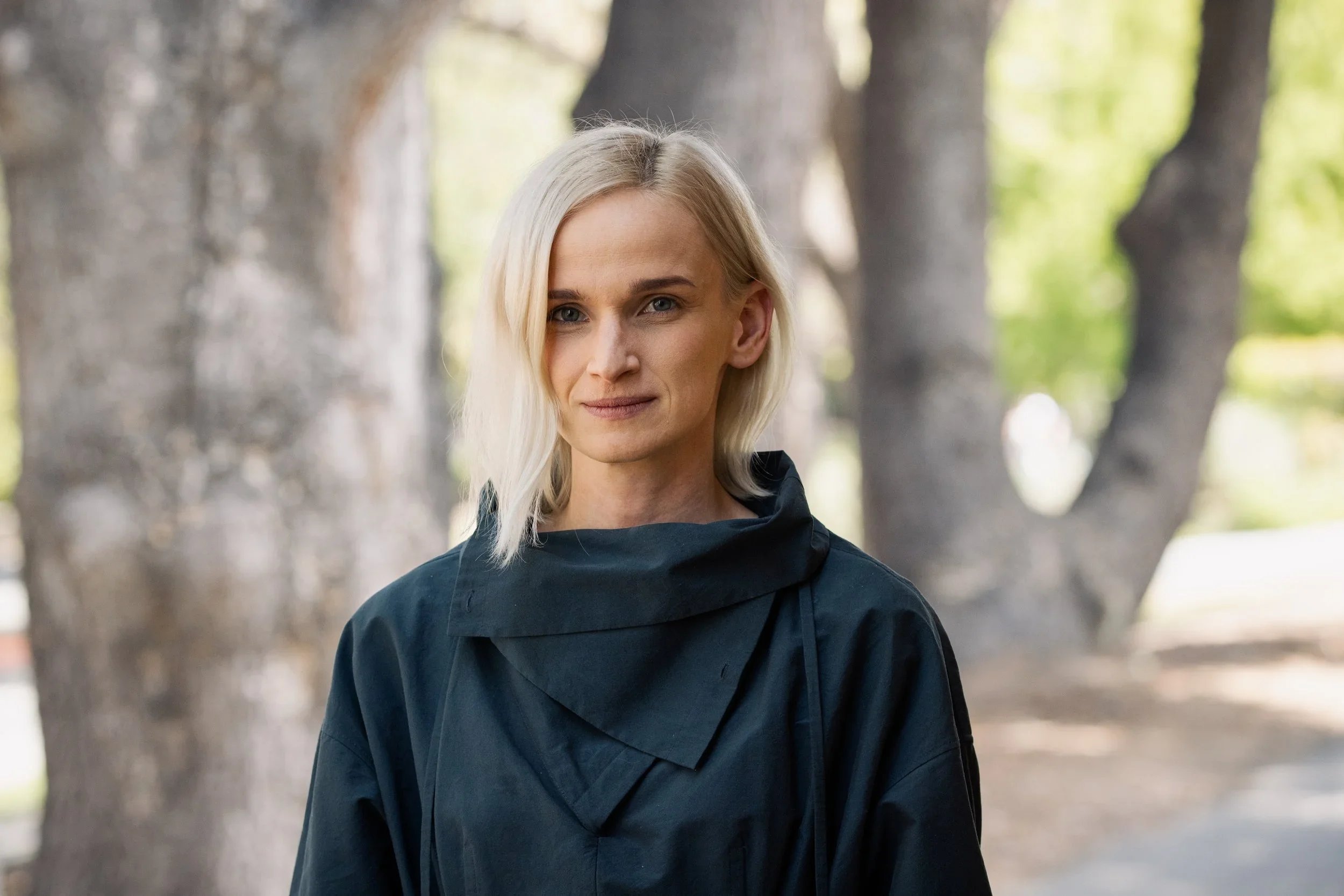
Charlotte McCurdy
Charlotte McCurdy researches and teaches design at the intersection of climate change, futures, and materials at the Stanford University d.school.
Her work has been exhibited around the world including at The Metropolitan Museum of Art, the London Design Museum, and the Cooper Hewitt Triennial. Previously she served as Assistant Professor and Senior Global Futures Scientist at Arizona State University and as Assistant Professor of Industrial Design at the Rhode Island School of Design.
Her work has been featured in The New York Times, The Guardian, CNN, Dezeen, Wallpaper, and Vogue. She was a member of NEW INC cohort 5 and holds a degree in Global Affairs from Yale University and in Industrial Design from the Rhode Island School of Design.
Teaching & Mentorship
Charlotte teaches design as a methodology for building agency. Her students frame important research questions, create original artifacts addressing real problems, and secure external support.
She fosters independence and agency by embedding research in context, connecting work to motivation, and sharing tools of design. The result is work that matters beyond the classroom and a network of researchers and builders who solve problems we don’t have names for yet.
-
As part of the Stanford d.school, I currently teach DESIGN 289 Redress, DESIGN 162A/B Advances Design, and DESIGN 101 History and Ethics of Design, and I am developing a new Intro Seminar with the support of an artsCatalyst Fellowship from the Stanford Arts Institute.
The Hasso Plattner Institute of Design at Stanford (the d.school) is where people learn to navigate complexity through making. We teach design as a way of working—not just aesthetics or problem-solving, but a fundamental capacity to understand needs, generate possibilities, and make ideas real in the world.Our approach is hands-on and human-centered. Students learn by doing: conducting research with real people, rapidly prototyping concepts, testing with users, and iterating based on what they discover. We bring together diverse perspectives—engineers, artists, business students, educators—because the most interesting challenges don't respect disciplinary boundaries. The work is collaborative, experimental, and focused on impact. Whether you're designing a medical device, a service system, or a policy intervention, you're always asking: What do people actually need? How might we build something better? And how do we make it real?
-
Redress is an advanced design elective exploring the intersection of fashion, sustainability, and biomaterials. Students develop research-driven proposals for new-to-the-world ideas through hands-on experimentation with emerging and vernacular technologies—negotiating more-than-human collaborations to investigate our impacts on planetary systems.
The course moves from problem discovery through proof-of-concept prototyping. Interdisciplinary teams from across all of Stanford pursue a design-led research process to create work that is both technically grounded and culturally resonant. Top projects represent Stanford at the Biodesign Challenge Summit in New York, presenting to leaders in art, design, science, and industry at MoMA.
Redress prepares students to work at the frontier of material innovation while building the kind of transdisciplinary fluency that industry partners and research collaborators increasingly demand.
Course is limited to enrolled Stanford Students.Inquiries from external partners interested in collaborating are welcome at cmccurdy@dschool.stanford.edu
-
Impact Studio is a two-quarter capstone course where Stanford design seniors tackle real challenges from mission-driven partners. Students work in small teams on projects at the intersection of planet, health, social impact, and biological futures—moving from deep research and synthesis through rapid prototyping to implementation-ready solutions.
This isn't theoretical work. Partners bring actual problems they're facing. Students engage directly with affected communities, build working prototypes, and deliver actionable concepts designed for real-world launch. Past projects have addressed LGBTQ+ youth mental health, National Park accessibility, retail sustainability, and climate-conscious product innovation.
The course demands professional-level collaboration. Students manage partner relationships, navigate complex stakeholder needs, and balance ambitious design thinking with practical constraints around viability and feasibility. By June, each team presents a tested solution, implementation proposal, and pathway to impact.
For students: This is your chance to do design work that matters. You'll integrate everything you've learned in the major while building the skills to operate as a designer in the world—managing ambiguity, leading teams, and delivering under real constraints.
For partners: You get a dedicated team of trained designers spending 20 weeks obsessing over your challenge. You'll receive fresh research insights, user-tested concepts, and detailed implementation plans—all grounded in human-centered design methods and delivered with an eye toward lasting impact.
See course website for more information.
-
Under Development
-
Arizona State University
Industrial Design Studio III
Contemporary Issues in Industrial Design
Design for Ecology and Social Equity
Advanced Industrial Design Studio II
Design Project I
Rhode Island School of Design
Advanced Studio: De-Industrial Design
Graduate ID Studio I: Discursive & Experimental Design
Biomaterials Research Group, Collaborative Study Project
Climate Crisis & Design
Thesis Open Research
Data Object
-
I maintain a standing offer to speak with design students and early-career researchers working at the intersection of climate, materials, and futures. If you're developing work in this space and want to talk through your thinking, I'm reachable and try to say yes to an initial conversation. Ongoing advisory relationships are considered case by case.